
Hyundai Santa Fe (TM): Body Electrical System / Rear Glass Defogger
Components and components location
| Component Location |
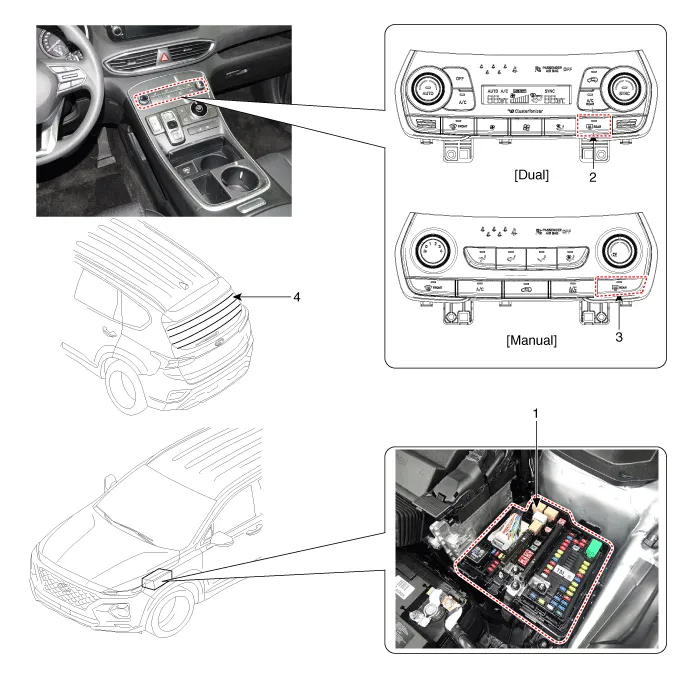
| 1. Rear
glass defogger relay (Buil-in engine room relay box) 2. Rear glass defogger switch (Dual type) |
3. Rear
glass defogger switch (Manual type) 4. Rear glass defogger |
Rear Glass Defogger Printed Heater. Repair procedures
| Inspection |
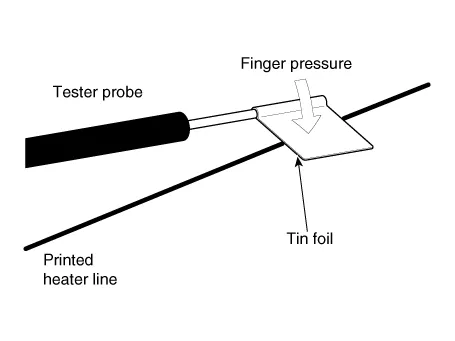
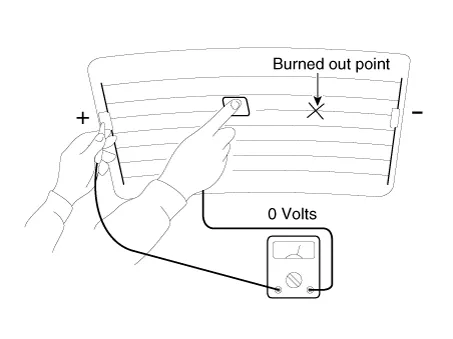
Wrap tin foil around the end of the voltmeter test lead to prevent damaging
the heater line. Apply finger pressure on the tin foil, moving the tin
foil along the grid line to check for open circuits.
|

| 1. |
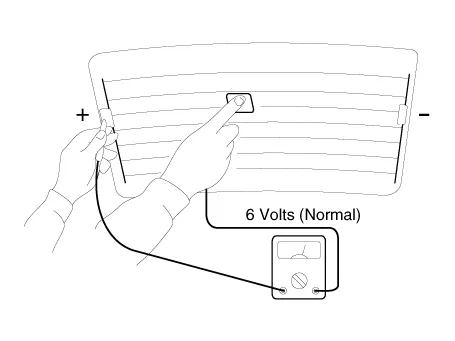
Turn on the defogger switch and use a voltmeter to measure the voltage
of each heater line at the glass center point. If a voltage of approximately
6V is indicated by the voltmeter, the heater line of the rear window
is considered satisfactory.
|
| 2. |
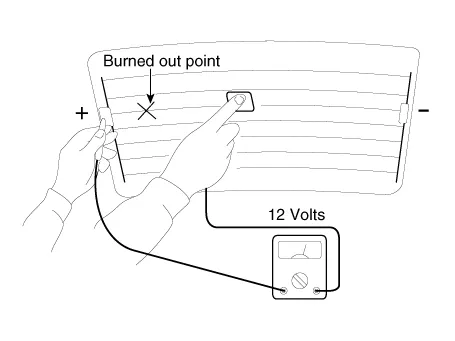
If a heater line is burned out between the center point and (+) terminal,
the voltmeter will indicate 12V.
|
| 3. |
If a heater line is burned out between the center point and (-) terminal,
the voltmeter will indicate 0V.
|
| 4. |
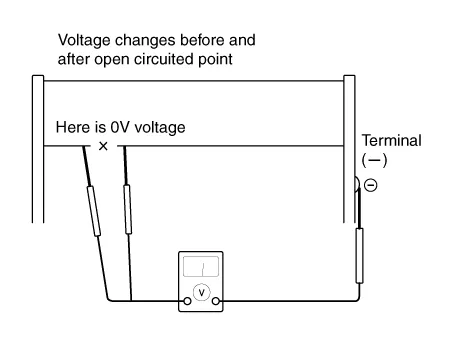
To check for open circuits, slowly move the test lead in the direction
that the open circuit seems to exist. Try to find a point where a voltage
is generated or changes to 0V. The point where the voltage has changed
is the open-circuit point.
|
| 5. |
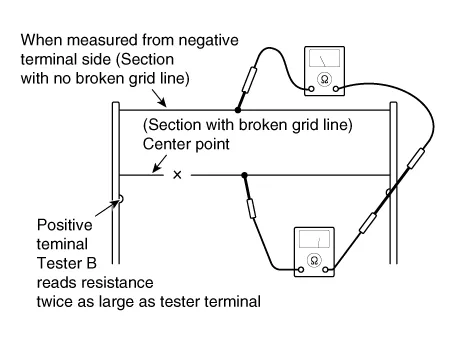
Use an ohmmeter to measure the resistance of each heater line between
a terminal and the center of a grid line, and between the same terminal
and the center of one adjacent heater line. The section with a broken
heater line will have a resistance twice that in other sections. In
the affected section, move the test lead to a position where the resistance
sharply changes.
|
| 1. |
Conductive paint.
|
| 2. |
Paint thinner.
|
| 3. |
Masking tape.
|
| 4. |
Silicone remover.
|
| 5. |
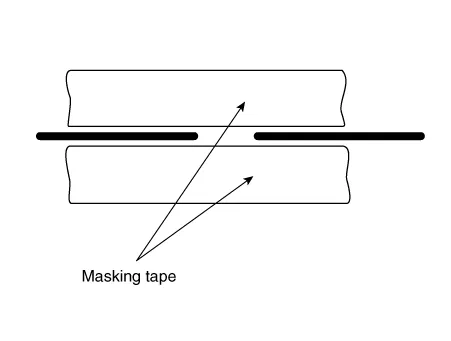
Using a thin brush :
Wipe the glass adjacent to the broken heater line, clean with silicone
remover and attach the masking tape as shown. Shake the conductive paint
container well, and apply three coats with a brush at intervals of about
15 minutes apart. Remove the tape and allow sufficient time for drying
before applying power. For a better finish, scrape away excess deposits
with a knife after the paint has completely dried. (Allow 24 hours).
|
Rear Glass Defogger Switch. Repair procedures
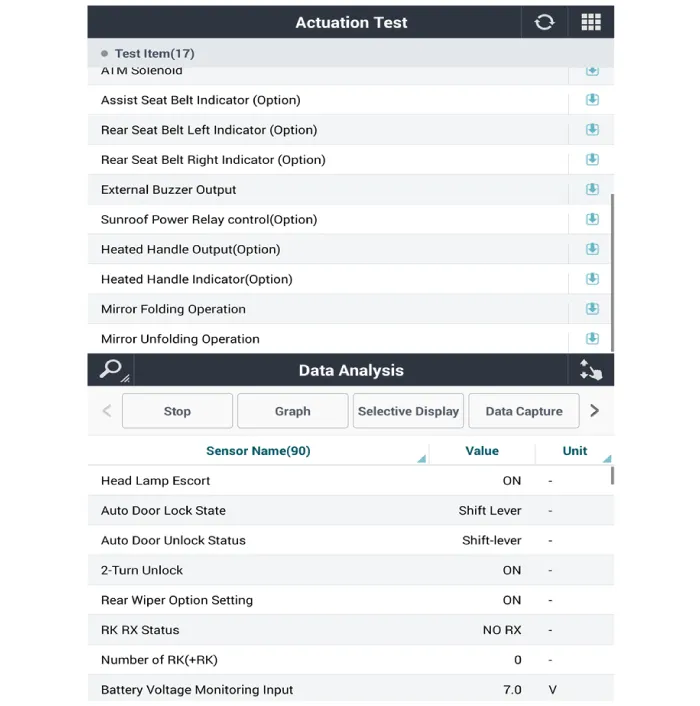
| Diagnosis with diagnostic tool |
| 1. |
In the body electrical system, failure can be quickly diagnosed by using
the vehicle diagnostic system (diagnostic tool).
The diagnostic system (diagnostic tool) provides the following information.
|
| 2. |
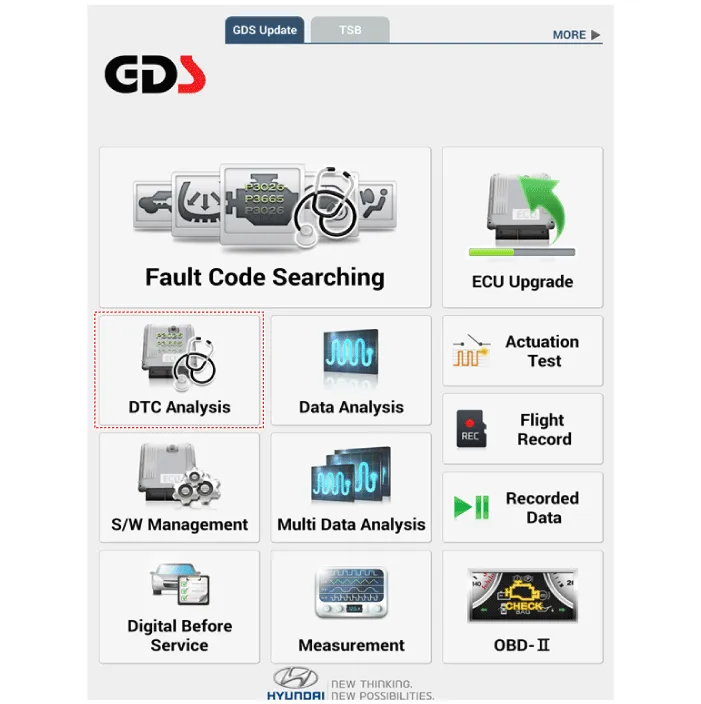
If diagnose the vehicle by diagnostic tool, select "DTC Analysis" and
"Vehicle".
|
| 3. |
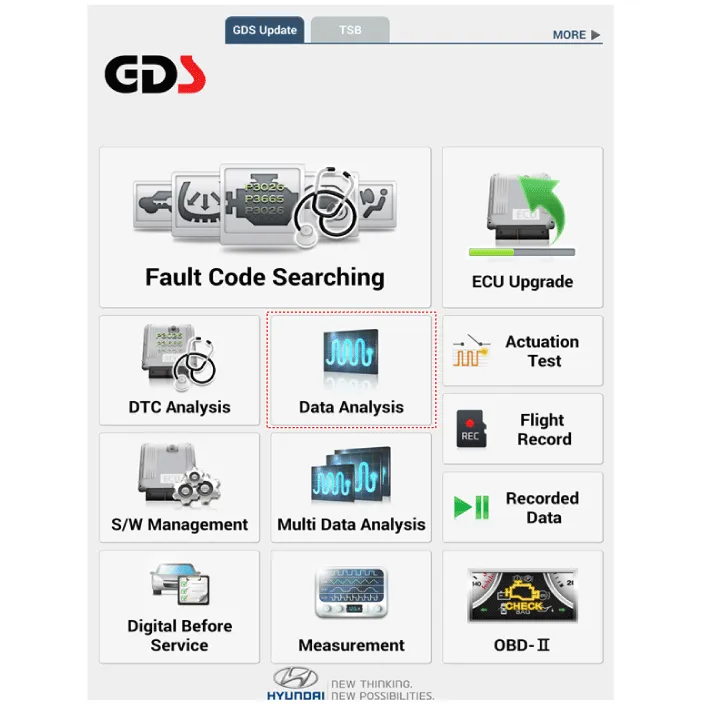
Select the 'Data Analysis' and 'Car model'.
|
| 4. |
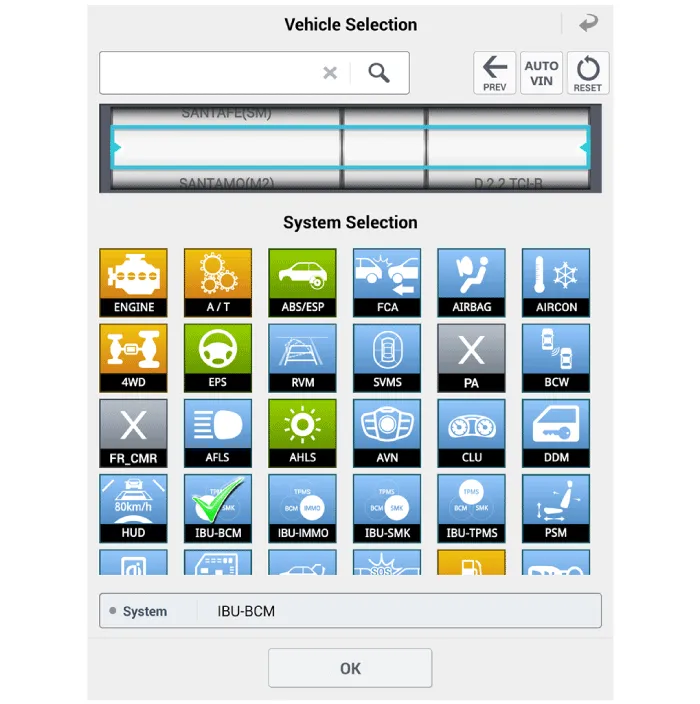
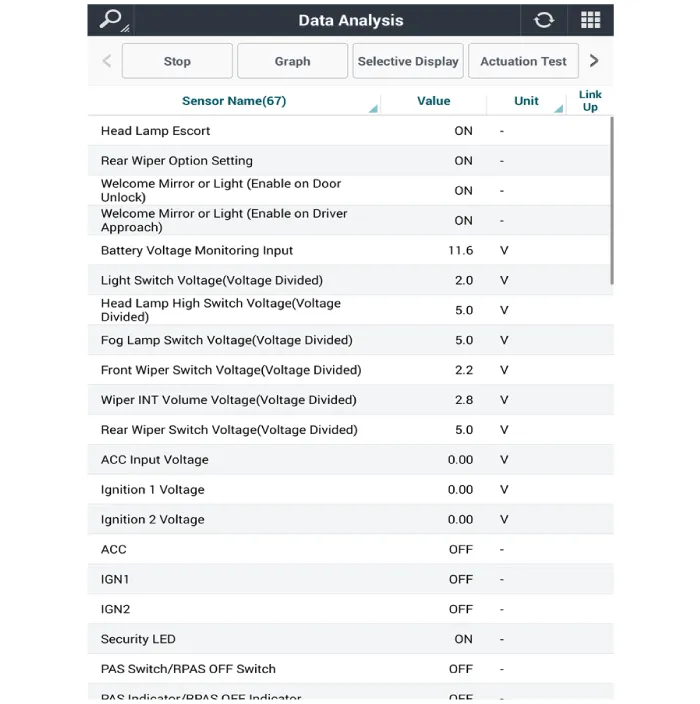
Select the 'IBU_BCM' to search the current state of the input/output
data.
|
| 5. |
To forcibly actuate the input value of the module to be checked, select
option 'Actuation Test'.
|
| Removal |
| 1. |
Disconnect the negative (-) battery terminal.
|
| 2. |
Remove the audio unit or the AVN head unit.
(Refer to Audio - "Audio Unit")
(Refer to AVN system - "AVN Head Unit")
|
| 3. |
Remove the heater and A/C controll unit.
(Refer to Heating,Ventilation, Air Conditioning - "Heater & A/C Control
Unit (Manual)")
(Refer to Heating, Ventilation, Air conditioning - "Heater & A/C Control
Unit (DATC)")
|
| Installation |
| 1. |
Install the heater and A/C control unit.
|
| 2. |
Install the audio unit or the AVN head unit.
|
| 3. |
Connect the negative (-) battery terminal.
|
Description and operation Function Of Safety Power Window When driver door power window auto-up switch is operated, safety function is activated.
Description and operation Description Power tailgate is an electro-mechanical system designed to provide power opening and closing of the tailgate through the push of a button of a remote key (fob), console switch, inner switch or an outside handle switch of the tailgate.
Other information:
Hyundai Santa Fe (TM) 2019-2023 Service and Repair Manual: General safety information and caution
Instructions (R-134a) When Handling Refrigerant 1. R-134a liquid refrigerant is highly volatile. A drop on the skin of your hand could result in localized frostbite. When handling the refrigerant, be sure to wear gloves.
Hyundai Santa Fe (TM) 2019-2023 Service and Repair Manual: Condenser. Repair procedures
Inspection 1. Check the condenser fins for clogging and damage. If clogged, clean them with water, and blow them with compressed air. If bent, gently bend them using a screwdriver or pliers. 2.
Categories
- Manuals Home
- Hyundai Santa Fe Owners Manual
- Hyundai Santa Fe Service Manual
- Fuel Delivery System
- Instrument cluster
- Lane Following Assist (LFA)
- New on site
- Most important about car
