
Hyundai Santa Fe (TM): ESP(Electronic Stability Program) System / Yaw-rate and G Sensor. Repair procedures
Hyundai Santa Fe (TM) 2019-2023 Service and Repair Manual / Brake System / ESP(Electronic Stability Program) System / Yaw-rate and G Sensor. Repair procedures
| Removal |
| 1. |
Turn ignition switch OFF and disconnect the negative (-) battery cable.
|

| 2. |
Remove the floor console.
(Refer to Body - "Floor Console")
|
| 3. |
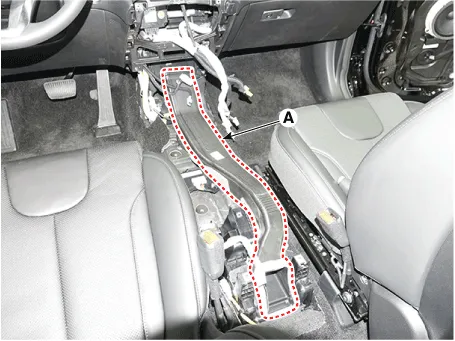
Remove the air duct (A) after loosening the mounting bolts (A).
|
| 4. |
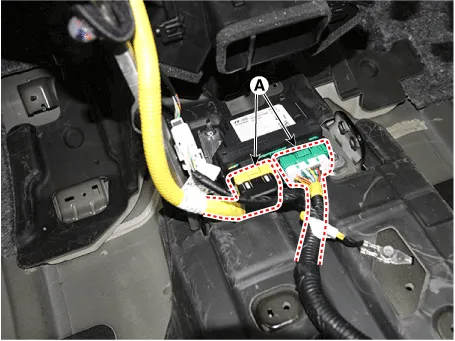
Pull up the lock, of the SRSCM connector, the disconnect the connector
(A).
|
| 5. |
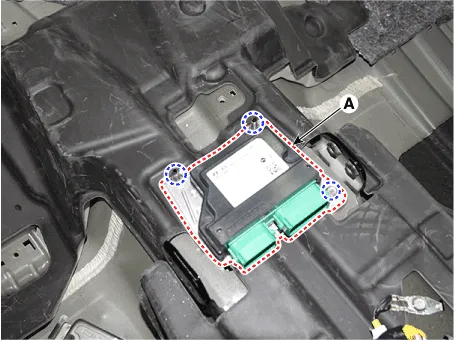
Remove the SRSCM (A) after loosening the mounting bolts and nuts.
|
| Installation |
| 1. |
To install, reverse the removal procedures.
|
| 2. |
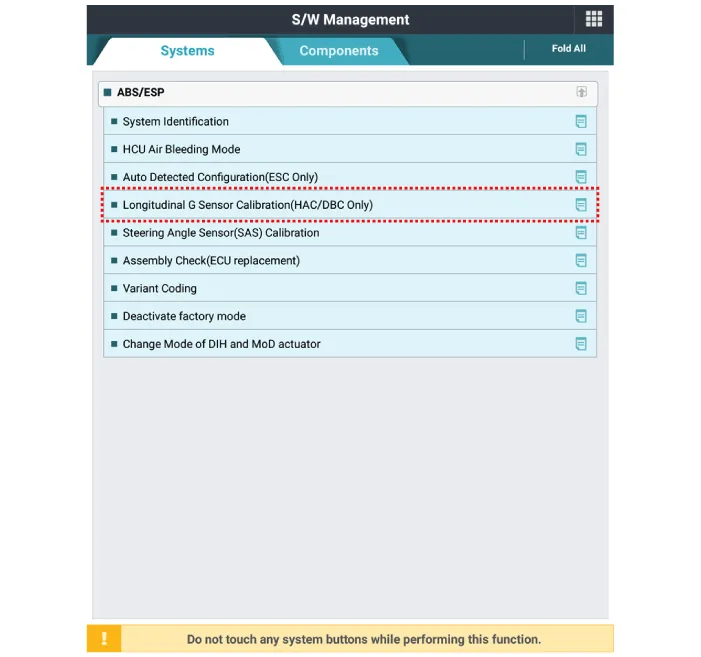
Perform Longitudinal G-sensor calibration in vehicle S/W Management
menu of the diagnostic tool.
|
| Adjustment |
As manual for diagnosis methods by using diagnosis device, the main contents
are as follows:
| 1. |
Connect self-diagnosis connector(16pins) located in the lower of driver
side crash pad to self-diagnosis device, and then turn the self-diagnosis
device after key is ON.
|
| 2. |
Select the "vehicle model" and "ABS/ESP" on diagnostic tool vehicle
selection screen, then select OK.
[Longitudinal G Sensor Calibration]
|
Schematic Diagrams
Other information:
Hyundai Santa Fe (TM) 2019-2023 Service and Repair Manual: Panorama Sunroof
Components and components location Component Location 1. Panorama sunroof 2. Panorama sunroof switch 3. Panorama sunroof motor & controller 4. Roller blind motor & slave controller Schematic diagrams Circuit Diagram Connector Pin Information No
Hyundai Santa Fe (TM) 2019-2023 Service and Repair Manual: Cruise Control System (CC)
Description and operation Description The cruise control system is engaged by the cruise "ON/OFF" main switch located on right of steering wheel column. The system has the capability to cruise, coast, accelerate and resume speed.
Categories
- Manuals Home
- Hyundai Santa Fe Owners Manual
- Hyundai Santa Fe Service Manual
- Horn
- Lane Following Assist (LFA)
- Instrument cluster
- New on site
- Most important about car

Copyright © 2026 www.hsafe4.com - 0.0215