
Hyundai Santa Fe (TM): Why didn’t my air bag go off in a collision? / Air bag inflation conditions
Front air bags
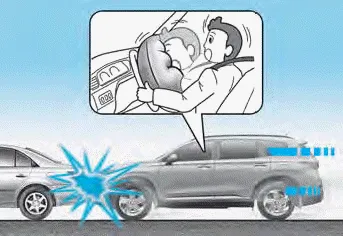
Front air bags are designed to inflate in a frontal collision depending on the severity of impact of the front collision.
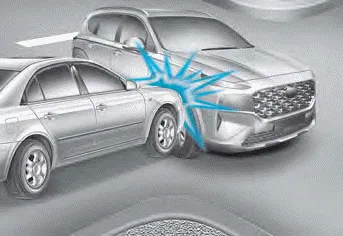

Side and curtain air bags
Side and curtain air bags are designed to inflate when an impact is detected by side collision sensors depending on the severity, speed or angles of impact resulting from a side impact collision.
Although the driver’s and front passenger’s air bags are designed to inflate in frontal collisions, they also may inflate in other types of collisions if the front impact sensors detect a sufficient impact. Side and curtain air bags are designed to inflate in side impact collisions, but they may inflate in other collisions if the side impact sensors detect a sufficient impact.
Also, the side and curtain air bags are designed to inflate when a rollover is detected by a rollover sensor. (if equipped with rollover sensor)
If the vehicle chassis is impacted by bumps or objects on unimproved roads, the air bags may deploy. Drive carefully on unimproved roads or on surfaces not designed for vehicle traffic to prevent unintended air bag deployment.
WARNING To reduce the risk of an air bag deploying unexpectedly and causing serious injury or death: Do not hit or allow any objects to impact the locations where air bags or sensors are installed.
In certain low-speed collisions the air bags may not deploy. The air bags are designed not to deploy in such cases because they may not provide benefits beyond the protection of the seat belts.
Other information:
Hyundai Santa Fe (TM) 2019-2023 Service and Repair Manual: Blower Resistor (Manual). Repair procedures
Inspection 1. Measure the resistance between the terminals. 2. The measured resistance is not within specification, the blower resistor must be replaced. (After removing the resistor) Replacement 1.
Hyundai Santa Fe (TM) 2019-2023 Service and Repair Manual: Rear Blower Motor. Repair procedures
Replacement 1. Disconnect the negative (-) battery terminal. 2. Remove the luggage side trim [RH]. (Refer to Body - "Luggage Side Trim") 3. Separate the blower motor connector (A) and loosen the mounting screws and remove the