
Hyundai Santa Fe (TM): Brake System / Brake oil. Repair procedures
| Replacement |
|

| 1. |
Turn ignition switch OFF and disconnect the negative (-) battery cable.
|
| 2. |
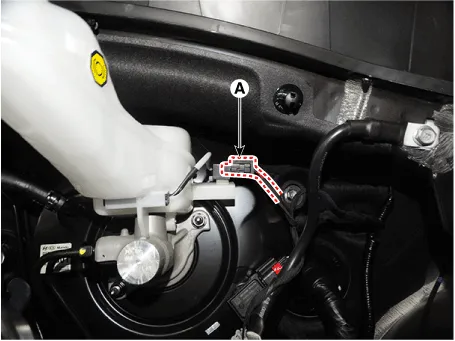
Disconnect the brake fluid level sensor connector (A).
|
| 3. |
Remove the brake fluid from the master cylinder reservoir with a syringe.
|

| 4. |
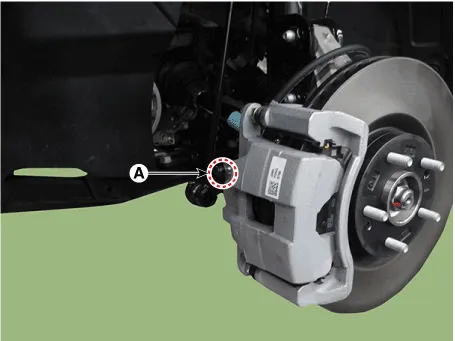
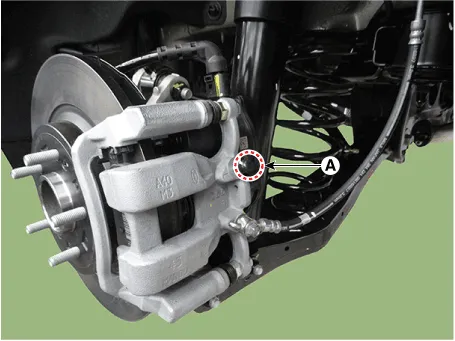
Loosen the bleed screw (A) and depress the brake pedal repeatedly several
times until the brake fluid reaches the caliper cylinder.
[Front]
[Rear]
|
| 5. |
Retighten the bleed screw and then make sure the brake fluid in the
reservoir is at the MAX (upper) level line.
|
| 6. |
Loosen the right-rear brake bleed screw (A) to allow air to escape from
the system. Then tighten the bleed screw securely.
[Front]
[Rear]
|
| 7. |
Re-tighten the bleed screw.
|
| 8. |
Have an assistant press the brake pedal several times to pressurize
it and keep it pressed.
|
| 9. |
Pump the brake pedal several times, and then loosen the bleeder screw
until fluid starts to run out without bubbles. Then close the bleeder
screw.
[Front]
[Rear]
|
| 10. |
Repeat the procedure for wheel in the sequence until air bubbles no
longer appear in the fluid.
|
| 11. |
Connect the negative (-) cable.
|
| 12. |
Connect the brake fluid level sensor.
|
Specification Fluid Type DOT 4 Reservoir Quantity (cc) MAX LEVEL A + B + C + D 493 ± 20 ON LEVEL B + C + D 206 ± 20 MIN LEVEL - 167 PARTIAL LEVEL C Pri : 63 D Sec : 49 CLUTCH LEVEL E -
Components 1. Brake member assembly 2. Stop lamp switch 3. Brake pedal arm assembly 4. Brake pedal pad
Other information:
Hyundai Santa Fe (TM) 2019-2023 Service and Repair Manual: Indicators And Gauges
Troubleshooting Troubleshooting Symptom Possible cause Remedy Speedometer does not operate Cluster fuse (10A) blown Check for short and replace fuse Speedometer faulty Check speedometer CAN line faulty
Hyundai Santa Fe (TM) 2019-2023 Service and Repair Manual: Photo Sensor. Description and operation
Description The photo sensor is located at the center of the defrost nozzles. The photo sensor contains a photovoltaic (sensitive to sunlight) diode. The solar radiation received by its light receiving portion, generates an electromotive force in proportion to the amount of radiation received which is transferred to th
Categories
- Manuals Home
- Hyundai Santa Fe Owners Manual
- Hyundai Santa Fe Service Manual
- Power Tailgate Module
- Parking Brake System. Electronic Parking Brake (EPB)
- Fuel Delivery System
- New on site
- Most important about car
