
Hyundai Santa Fe (TM): General Information / Warning and Caution Labels
| Warning and Caution Labels |
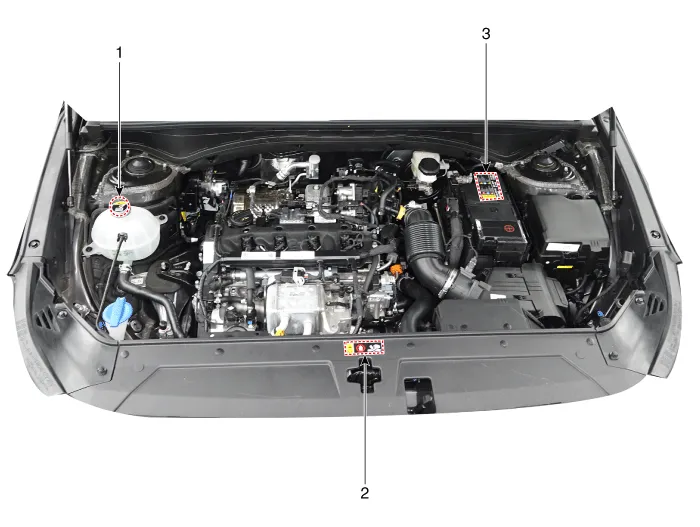
| 1. Radiator cap
caution 2. Fan caution |
3. Battery caution |
|
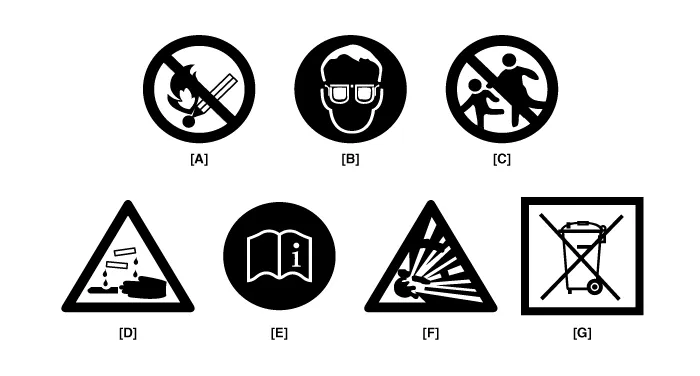
A. Keep lighted cigarettes and all other flames or sparks away from the battery. |
|
B. Wear eye protection when charging or working near a battery. Always provide ventilation when working in an enclosed space.
|
|
C. Keep batteries out of the reach of children because batteries contain highly corrosive SULFURIC ACID. Do not allow battery acid to contact your skin, eyes, clothing or paint finish. |
|
D. If any electrolyte gets into your eyes, flush your eyes with clean water for at least 15 minutes and get immediate medical attention. If possible, continue to apply water with a sponge or cloth until medical attention is received. If electrolyte gets on your skin, throughly wash the contacted area. If you feel a pain or a burning sensation, get medical attention immediately. |
|
E. Always read the following instructions carefully when handing a battery. |
|
F. Hydrogen, which is a highly combustible gas, is always presents in battery cells and may explode if ignited. |
|
G. An improperly disposed battery can be harmful to the environment and human health. Always confirm local regulations for battery disposal. |
|
Battery Itself |
|
||||||
|
Battery on Vehicle |
|
After reconnecting or recharging a discharged battery, the ESP OFF indicator
may illuminate.
In this case, turn the handle half way to the left and right whilst
the ignition switch is in the ON position.
Then, restart the engine after the ignition is OFF.
The ESP OFF indicator may turn OFF.
If the ESP OFF indicator does not turn OFF, have the system checked.
(Refer to the DTC guide)
|

Identification Number Identification Number Description Vehicle Identification Number 1. World Manufacturer Identifier (WMI) - KMH : Passenger vehicle or MPV(Multipurpose Passenger Vehicle)/SUV(Sports Utility Vehicle)/RV(Recreational Vehicle) 2.
Lift and Support Points [Two-Post Car Lift] 1. Place the lift blocks under the support points as shown in the illustration.
Other information:
Hyundai Santa Fe (TM) 2019-2023 Service and Repair Manual: Keyless Entry And Burglar Alarm
Description and operation Description Burglar Alarm State [B/A State] B/A State Description DISARM 1) In "DISARM" state, no vehicle start inhibition.
Hyundai Santa Fe (TM) 2019-2023 Service and Repair Manual: IMS (Integrated Memory)
Description and operation Description The optimal seat position set by the driver is memorized into the power seat unit by using IMS switch. In case of the position change, the seat can restore its preset position by IMS switch.
Categories
- Manuals Home
- Hyundai Santa Fe Owners Manual
- Hyundai Santa Fe Service Manual
- Fuel Delivery System
- Emission Control System
- Engine Electrical System
- New on site
- Most important about car
